

I spent the first 22 years of my life in Indiana. I’ve maintained connections there even since moving to Chicago. For the past three years I’ve attended an annual conference organized by the IU Center for Rural Engagement. The conference brings together people from all disciplines and fields (literally) who are fighting for the well-being of rural and small town Indiana. At this yearly convergence, I’ve met nurses who formed underground networks in counties that lost *all* of their maternal healthcare post-Roe.1 I’ve met queer organizers from Spencer, Indiana, the smallest town in the U.S. with an LGBTQ+ community center and Pride festival.2 I’ve met university students collecting oral histories of Black rural elders.3 I’ve met community members who are sustaining their county’s only women’s recovery house by hunting wild game, growing vegetables, and baking bread.4 In other words, I’ve met people who are the definition of rural resilience. They rarely get any spotlight. But I think we could all learn something from them.
Every conference I’ve attended since 2024 has been deeply impactful. But this year had bite. So much funding has been lost. The state of Indiana has gleefully slashed budgets in tandem with the federal government. An already-patchy safety net has had giant holes punched through it as life continues to get more unaffordable. Can you guess what Indiana’s minimum wage is? It’s $7.25.5 Yep. You read that correctly. Around 41% of jobs in Indiana don’t pay living wages.6 What happens when almost half of the employment in the state does not cover basic necessities? Take another guess - how many new data centers have been proposed in Indiana recently?
36.
Thirty. Six.7
Is it all connected? You tell me.
The bleak news is nothing new. Rural and small town America have faced challenges for decades. Hundreds of rural hospitals nationwide have closed and roughly 30% more are at risk of closing soon.8 Over half of all recorded drug overdoses in the U.S.A. have occurred just within the past 5 years,9 with fentanyl-laced meth being one of the main culprits,10 hitting rural America especially hard.11 Rural America often has higher rates of homicide, incarceration, suicide, overdose, and poverty than urban America, despite our society’s obsession with demonizing urban life.12 Academics and activists speak of this as the rural “sacrifice zone.”13 Again, nothing new.
What is new is that more and more of the country is waking up to the fact that rural America is a frontline. It has been for decades, but our society too often does not pay attention. Our collective neglect has built cover for power to move in the shadows. The zeitgeist may not pay attention to rural America, but Meta and Google sure do. Oil and coal industries sure do. Rare earth mining companies sure do. Cartels sure do. The lifestyle of urban America is maintained in part by the natural resources and labor of rural America. Not only that, people in power rely on having a place where things can be made invisible. Reservations for Indigenous people? The infrastructure of mass incarceration? Pipelines? Nuclear plants? The Silk Road of drug cartels? The scariest environmental degradations? The human trafficking of agricultural labor forces? The roll-back of child labor laws? Cancer rates that should be a “canary in the coal mine” for us all? A nation with lots of skeletons needs a closet. Rural America is too often a place where collective sins get disappeared.
Thanks to the amount of media attention towards data centers, more and more people are paying attention to rural areas. However, the media doesn’t always tell the stories of the kind of people you can meet at this yearly conference in rural Indiana. It doesn’t always reflect the decades of experience in rural survival that people are bringing to these most recent fights. I’m no media outlet, but if I can offer any platform whatsoever to highlight how people are fighting back on the frontlines of Indiana, I’ll do it.
If we turn away, we do so to our own detriment.
Ok, let’s get into it.
Let’s start with the young people. The conference was held in French Lick, Indiana. Students from the local high school set up a research room where they presented their final projects from U.S. history class. It wasn’t just any U.S. history though - the students were tasked to focus on people or events from rural communities. The projects were incredible. One student presented about David Drake, a Black man born into slavery who learned how to read and write and sent secret messages out on pottery he made at the stoneware factory where he was enslaved.14 Another student presented on Silas Soule,15 a white abolitionist who was a conductor on the Underground Railroad as a teenager, fought for the Union in the Civil War, and then refused orders to participate in the Sand Creek Massacre against the Arapaho and Cheyenne, instead testifying against his commanding officers at a military tribunal. He was killed in retribution. Another student presented about the 1970 stand-off between Puyallup tribal members and local authorities in Tacoma, Washington that led to a court case codifying Indigenous fishing rights.16 One of my personal favorites was a project about Karen Silkwood, a union activist turned whistleblower about her local nuclear power plant who was mysteriously killed in a car crash on her way to deliver testimony to The New York Times.17
It wasn’t just the projects themselves that were impressive in an era where truth-telling about U.S. history is being silenced. The social context of these kids is really important. These students live in Orange County, Indiana. A 2021 study found that 27% of children in the region have a direct household member who is incarcerated, and 51% of children have any family member who is incarcerated.18 Rates of poverty and addiction in the region are high. Economic opportunities are scarce and social problems are steep. These kids face a lot of challenges. They need this history. This rural history. They need to see themselves and their struggles in these stories. These rural stories. These presentations were not just interesting due to the national political climate. They were a profound window into what education can be in a place like Orange County, Indiana, and why it matters.
As you might have surmised, Indiana is deeply impacted by mass incarceration. For some context, Indiana has the 3rd highest prevalence of meth confiscations in the nation, and Evansville, Indiana was once described as the meth capital of the world.19 Indiana has also been hit hard by opioids; its economy loses approximately $1.6 billion in gross state product every year due to opioid-related suffering.20 Mass incarceration has been the leading response to meth, to opioids, and to poverty. Many communities lack resources to support the currently and formerly incarcerated. Two recent projects are trying to change that. One is the IU Prison Arts Initiative, a program that began in 2022 to offer arts classes to incarcerated students throughout the state.21 The other is Positive Expectations, a re-entry program taught in some rural county jails that began in 2023.22 Both programs were at the conference this year and spoke about being the first program of their kind in many Indiana prisons and jails, despite the fact that mass incarceration has been plaguing the state for decades. Some of the audience members at the conference spoke up about how no similar programs existed in their county yet, particularly re-entry support. Funding was named as the biggest barrier. Both programs were partnering with researchers at IU to document the outcomes of their programs in hopes that hard data will help bring in more funding. Unfortunately, data about positive outcomes does not always translate into political will, nor can it create money where there is none.
Speaking of political will, though, some of the presentations had good news to share. An impressive presence at the conference multiple years in a row have been rural communities who are undergoing rapid demographic change and finding ways to support new migrant populations. One presentation this year was from Daviess County, a largely rural county in southern Indiana, which is now home to the second largest Haitian population in the state.23 Most recent arrivals from Haiti are employed in a local turkey processing plant. Over the last few years, the Purdue Extension Service has been supporting local helping professionals and Haitian community leaders to develop culturally appropriate support for migrant families. The effort involved a research team, community stakeholders, and Extension educators. The initiative shared its research findings and involved all parties in developing a digital skills training program, a community fair with art, music, food, and storytelling, health education sessions at local churches and libraries, infographics and wellness kits in Haitian Creole, workshops on maternal health by and for Haitian women, and case management services.24 The presenters described how community resistance was present on all sides and trust took years to build. However, presenters described that the efforts have been a success and are leading to the creation of a Haitian-led non-profit organization to continue the services. Presenters noted that, at this point, some of the hardest challenges are coming from the outside, such as the federal government removing Temporary Protected Status for Haitians and stoking hateful rhetoric about the Haitian community.25 The political will locally and the political will nationally are not aligned.
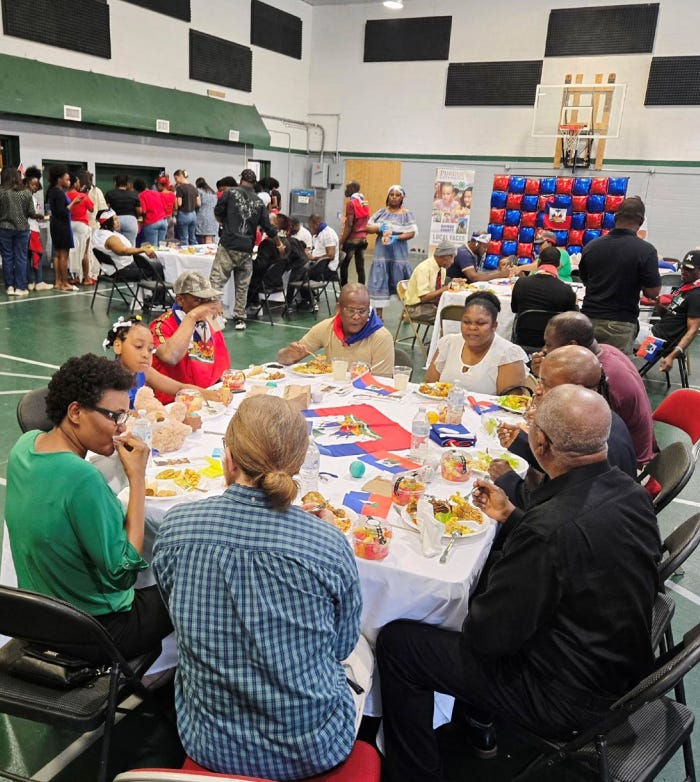
Community fair for Haitian Flag Day in Daviess County, May 17th, 2026. Photo courtesy of Purdue Extension Services.
At the conference in 2025, we heard from a program called The New Neighbors Education Center, an effort to help rural and small town areas in southern Indiana with rapid demographic change.26 The presentation included teachers from the small town of Seymour, IN, which now has one of the highest Guatemalan populations in the state, most of whom work at local egg processing facilities.27 The New Neighbors Education Center provided assistance to teachers in Seymour who now have classrooms where 36% of students are new English-learners.28 A National Geographic feature on the town highlighted the fact that most of the newcomers are from Chuj Indigenous communities and grew up in rural areas; Chuj migrants spoke about the benefits of coming to a small town in the U.S. compared to a big city and that their presence in the local economy is generating income both for Seymour and for their rural hometowns in Guatemala.29 People who would assume that places like Seymour, IN have no political will for demographic change are wrong. As one presenter commented, “Change is hard,” but “a lot of times we don’t give people enough credit.”
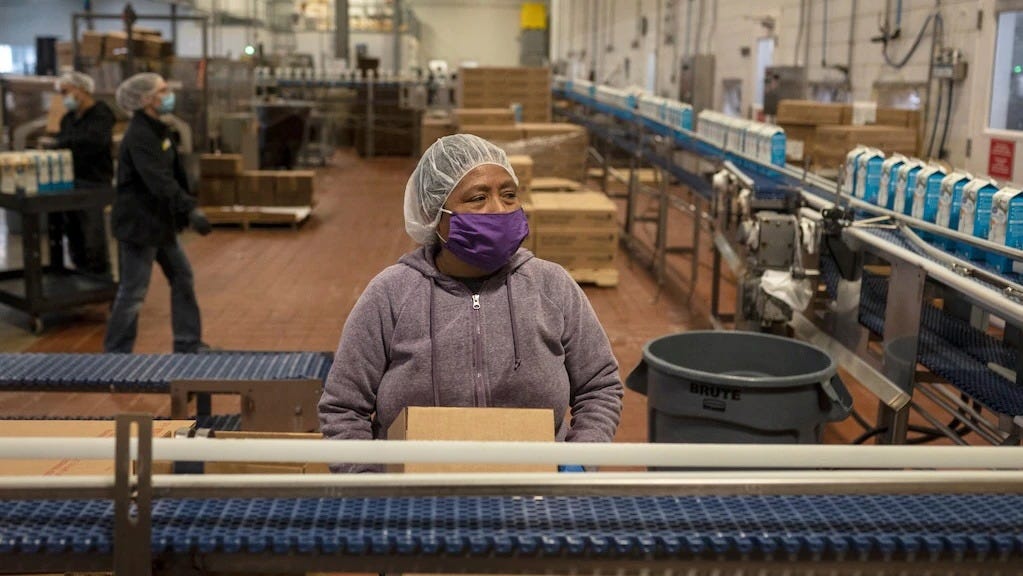
Julie Castro, an immigrant from Guatemala, examines cartons of eggs at one of several Rose Acre Farms facilities in Seymour. Image courtesy of National Geographic.
A common thread between all of these towns is the meat processing industry. Some of the most influential lawsuits in the early 2000s that “rubber stamped” the exploitation of undocumented migrant labor involved the meat processing industry.30 This is nothing new. However, what is new is the rise in child labor. Recently, more and more states have been rolling back child labor laws, in no small part due to the increasing reliance on child labor in the meat processing industry.31 An 2023 investigation by NBC News found that illegal child labor had increased 88% since 2019, largely due to an influx of migrant children working night shifts at meat processing plants.32 In January 2025, Indiana significantly rolled back protections for child laborers, in line with changes at the federal level.33 In March 2026, Indiana eliminated its Youth Employment System, which had previously monitored child labor in the state. The database itself had been a stop-gap system after Indiana eliminated work permits and stripped the Department of Education of oversight over child labor.34 It’s not just the illegal labor exploitation of undocumented adults that is growing migrant populations in small towns and rural areas. It is also the targeted exploitation of children. Local efforts in places like Daviess County and Seymour to support migrant families are operating in a political climate where the systematic exploitation of migrant children is being given the green light. As state infrastructure of protection is being stripped away, communities are having to build their own safety nets.
The question of well-paying, dignified work in Indiana, or the lack thereof, is a common theme at these conferences year after year. On that note, one of the strangest parts of the conference this year was a presentation by two out-of-state consultants (one of whom works for the Art Institute of Chicago). The State of Indiana hired these two consultants to do a “strengths-based assessment” of Indiana’s social infrastructure and social capital. What the consultant team found was interesting. But how they interpreted it felt…off.
Their assessment showed that Indiana has one of the highest rates of volunteering of any state in the nation. Apparently Indiana is top in the country for labor contributed through volunteerism, with an estimated economic value of $3.6 billion.35 And within Indiana, rural areas have some of the highest rates of volunteering. That is quite fascinating. Turns out we actually are a state of Leslie Knopes. The consultants at first tied this to America’s “loneliness epidemic” and how volunteering is frequently offered as an important solution to loneliness, suggesting that Indiana has protective factors against loneliness that other states are missing. All very inspiring.
But where the team took it from there was…odd. They brought up tax returns of rural community initiatives and showed that the organizations ran entirely on volunteer labor - no one was getting paid. And they posed the question: “Rather than seeing this as a deficit, what if we saw this as a strength?” and then argued that maybe instead of trying to get more people “paid and professionalized,” Indiana should view its enthusiastic volunteer base as social infrastructure that is “already working the way it should be.” Because this combats the “decline in togetherness,” apparently.
These consultants were paid for their labor, of course.
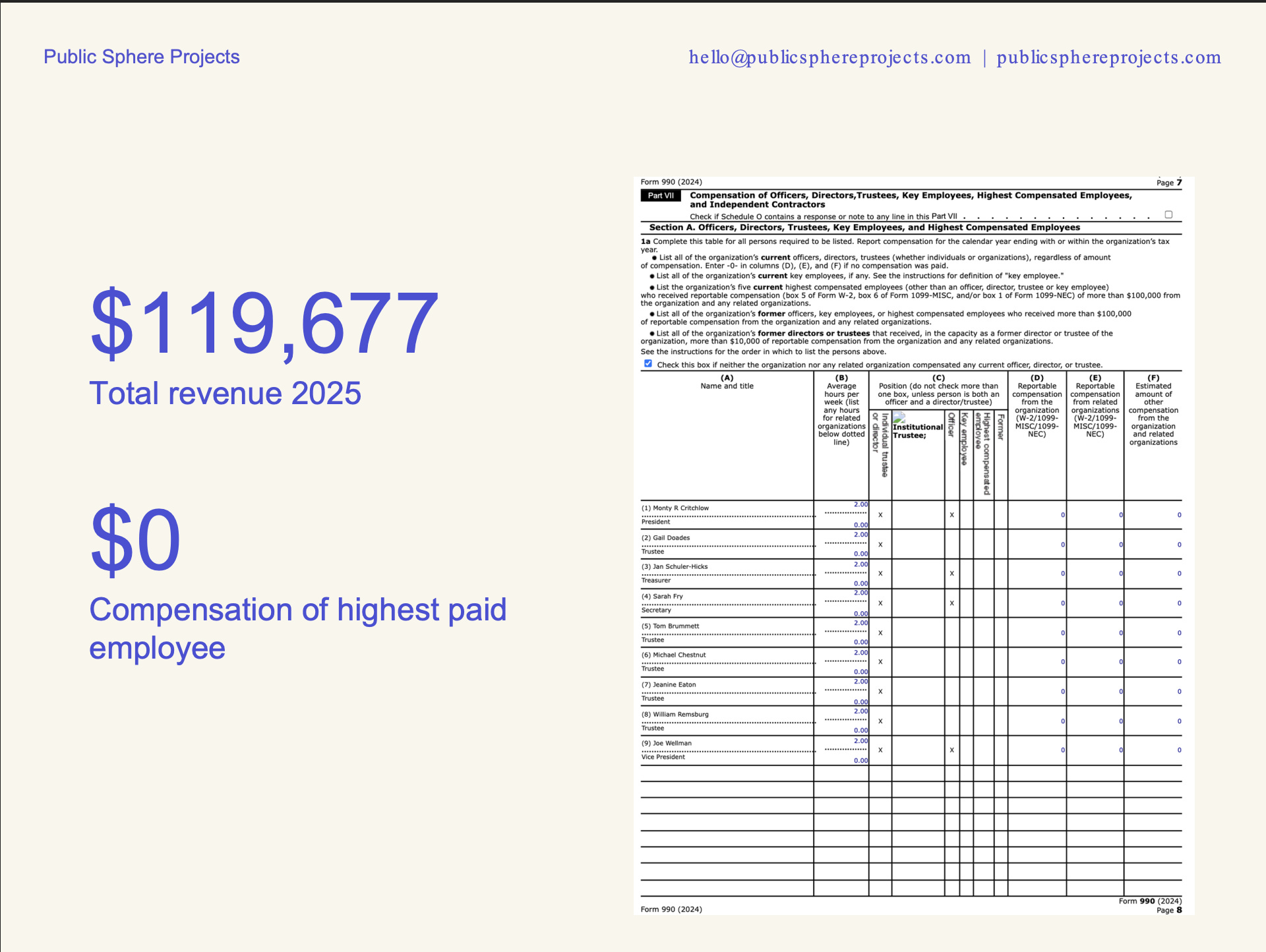
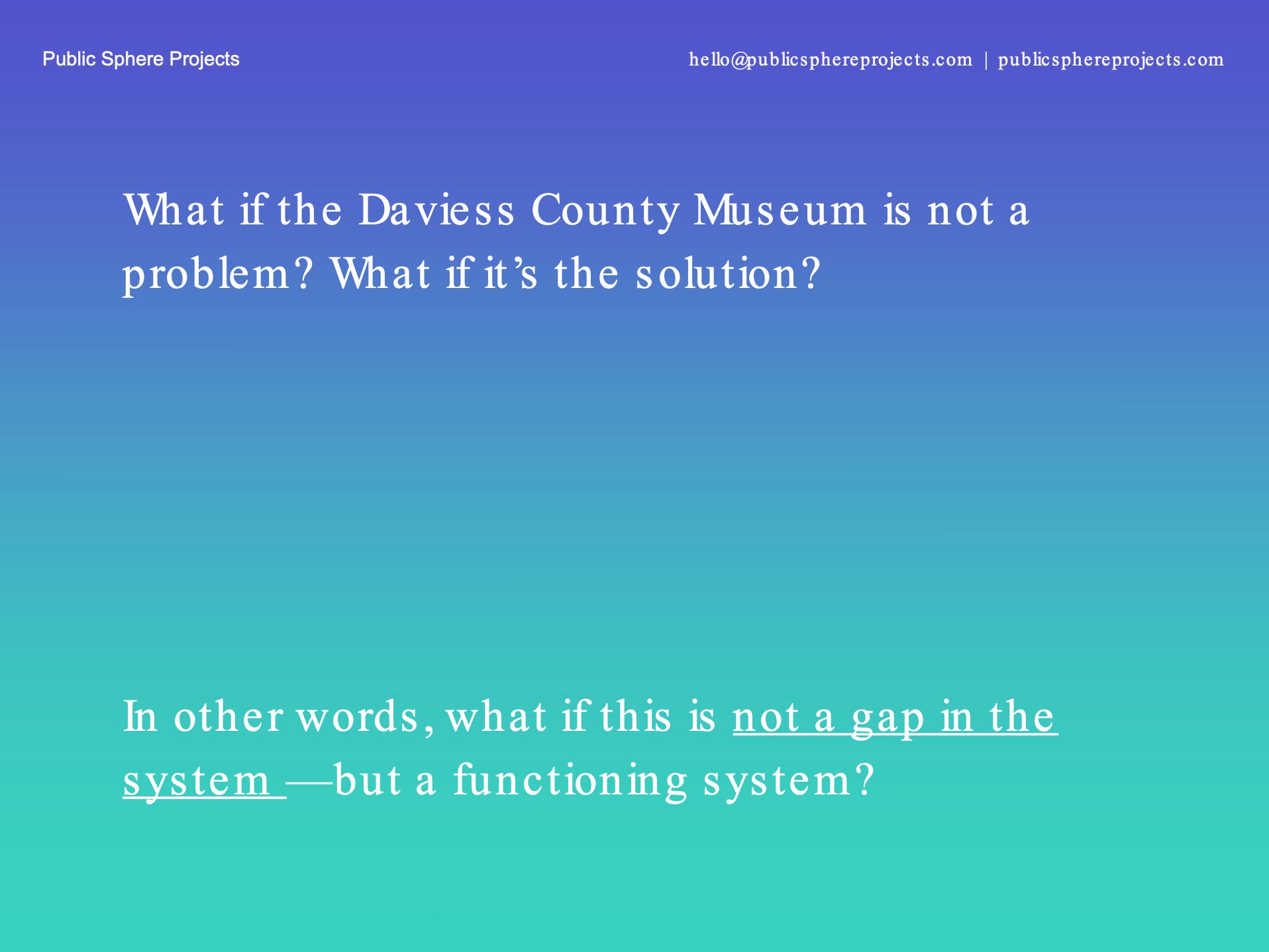
Selected slides from the keynote36
Many people at the conference were unimpressed by this assessment, and that is putting it politely. The team made no attempts to reconcile the high rate of volunteering in Indiana with the fact that Indiana falls in the bottom 5-10 of all states in many health and quality-of-life outcomes.37 Volunteering may help loneliness, but it doesn’t seem to solve poverty. As we already mentioned, 41% of jobs in the state do not pay a living wage.38 Food insecurity impacts 14% of the state and has increased over the past 5 years.39 Many are reliant on SNAP benefits that require proof of 20 hours of employment or volunteering every single week.40 Many people who are involved in the criminal justice system have community service requirements. (For the record, Indiana’s rates of incarceration are nearly double that of Illinois, where the Art Institute of Chicago consultant currently lives).41 Indiana struggles with poverty, lack of socioeconomic opportunity, mass incarceration, and battered social safety nets. Rural areas are frequently the hardest hit.
Did the consultants consider that so many people in Indiana volunteer (a) because they have to in order to maintain public assistance or stay out of jail (b) to help keep their community alive amidst decades of disinvestment, neglect, and crumbling public infrastructure? And loneliness might be the least of the worries here? And their recommendation is to……..not pay people?? And these out-of-state consultants are being paid by the state to give this advice to the state? The state government that has been gleefully slashing budgets already?
It was messy.
The data about Indiana having such a strong culture of volunteering is genuinely interesting. I agree, people being involved in their communities is a strength. It also confirmed what so many of us in the audience knew about the places where we grew up, the special resilience we know is there. It is cultural. But the fact that so much social good in the state gets done by volunteers also might be a symptom, a symptom of poverty in particular. Advocating to the state government that it’s a good thing that $3.6 billion worth of social infrastructure is run by unpaid labor is…a big swing and miss. The state is so short on living-wage jobs, which is one of the only lasting solutions to poverty. So many of us who attended the conference just wanted to yell: “screw you, pay us!!!” In other words, the audience had a healthy dose of cynicism about how the state government would run with those consultants’ recommendations. While the consultants presented themselves as passionate advocates for Hoosier communities, their conclusions felt like an endorsement of the abandonment and scarcity so many rural communities already face.
Plenty of experts at the conference could have presented the same data about volunteerism but reached a different conclusion about how well-paying jobs and strong social networks can work together. One such expert who presented at the conference was the sole employee of a pilot program for “mobile integrated health” in Greene County, Indiana.42 This rural county faced strain on their emergency services because people had so much trouble accessing primary and preventative care and just waited for things to get bad enough to call 911. The county has zero public transportation, high rates of poverty, an aging population, lack of internet and cell service, and a dispersed population with few providers (i.e. long distances to travel for care). This pilot program created a non-emergency medical van staffed by a nurse practitioner/EMT that did home visits. These home visits focused on:
Following up after hospital discharges, ensuring continuity of care
Providing in-home visits for people adapting to new medical regimens like insulin shots or oxygen, offering support, education, and troubleshooting
Connecting people with other social services like home healthcare, hospice, and mental healthcare, as many qualified but were falling through cracks
Bringing mobile Starlink service to homes without internet or cell service to conduct telehealth visits with primary care providers
Some patients released from hospital were automatically scheduled for follow-up with the mobile unit. But any resident could call at will and expect service within 24-48 hours. ONE person getting paid to do this job full time reduced hospital re-admissions by 76% and reduced 911 usage by 45%. Imagine if her mobile unit had a team of paid staff? The patients she visited often interacted with volunteers too - usually from churches or food pantries - but these patients still lacked vital medical infrastructure. The speaker talked about how frequently she coordinated with volunteer support in her patients’ lives - oftentimes friends, family, neighbors, or church volunteers who called the mobile unit on the patient’s behalf, or were present in the home to help learn care routines. It seems like a great example of how smart social investment that creates well-paying jobs AND volunteer involvement could, should, work together. It also feels like proof of why volunteerism cannot meet all needs. As with so many other people at the conference, this presenter reported that funding for the pilot program had run out. Not only that, the one hospital in her county just announced it was probably going to close.
If you couldn’t tell, money can be in short supply in Indiana. One interesting exception is opioid settlement money. Since 2022, states, counties, and municipalities who opted into the landmark lawsuit against pharmaceutical companies for their role in the opioid crisis have started receiving settlement money. With that funding have come tough questions about how to spend it. The past few years at this conference, people from across rural Indiana have presented on the ways their communities are putting the opioid settlement money to use. Most communities face similar complex questions:
What is the best way to coordinate between local, county, and state levels to prevent duplication and ensure gaps are filled?
How do we follow regulations of the settlement, and what is oversight for potential misuse of the money? (In particular, law enforcement has been pushing to get the opioid settlement money for their own budgets when that is actually prohibited by terms of the settlement, but some places have been allowing it, much to the alarm of other stakeholders. Other jurisdictions report political favoritism and “careless” spending determining the use of these hard-won funds.)
Do we prioritize maximum number of people reached or comprehensiveness of what is offered (breadth or depth)?
Do we invest in new infrastructure, innovation, and under-funded grassroots initiatives at a time when future funding is uncertain? Or do we improve what already exists that has other sources of funding secured?
How do we prioritize input and participation of those most impacted, as well as those with the most experience responding to the opioid crisis over the past decades?
How do we grapple with feelings that the settlement money is not even close to justice in mitigating the harm done? How do we grapple with nihilism that it “doesn’t matter” how the funding gets used since “it’s not going to change the bad things that happened?”
How do we navigate ongoing complications like the fact that so much fentanyl is actually mixed with meth and crack - as well as the new “bad guy” in town, xylazine - but many of the regulations of the settlement are very specific to opioids or assume an “opioid only” approach?
Orange County got their opioid settlement money early on and decided on a coordinated approach. Opioid settlement money now helps fund a county-wide taskforce coordinating prevention, treatment, and recovery. Prior to the opioid settlement money, the county had zero outpatient treatment available. Now, Orange County is home to a federally qualified health center offering medication assisted therapy and talk therapy, the Safe Haven Recovery Engagement Center that helps people in recovery with housing, employment, and peer support, a youth mentorship program, mental health education in K-6 schools, work-out groups for people in recovery, an LGBTQ+ support group, a mobile harm reduction unit, and a transportation program for people involved in the criminal justice system (the county still has no public transportation).43 Prior to the opioid settlement money, grassroots efforts had very little luck getting funding. The data about positive outcomes from the programs supported by opioid money has helped the county reach other sources of funding they previously could never reach.
The town of Jasper in DuBois County decided to conduct a research study with the help of the IU School of Public Health.44 The research team conducted a community survey, slowed down the decision-making process on the government level to involve other stakeholders, and eventually built a grant application process that will roll out over the next year.
Lots of communities could learn from the thoughtfulness, innovation, and resourcefulness of how some rural communities are using opioid settlement money. Rural communities often face different scarcities than urban communities and find creative solutions that might be helpful in lots of settings.
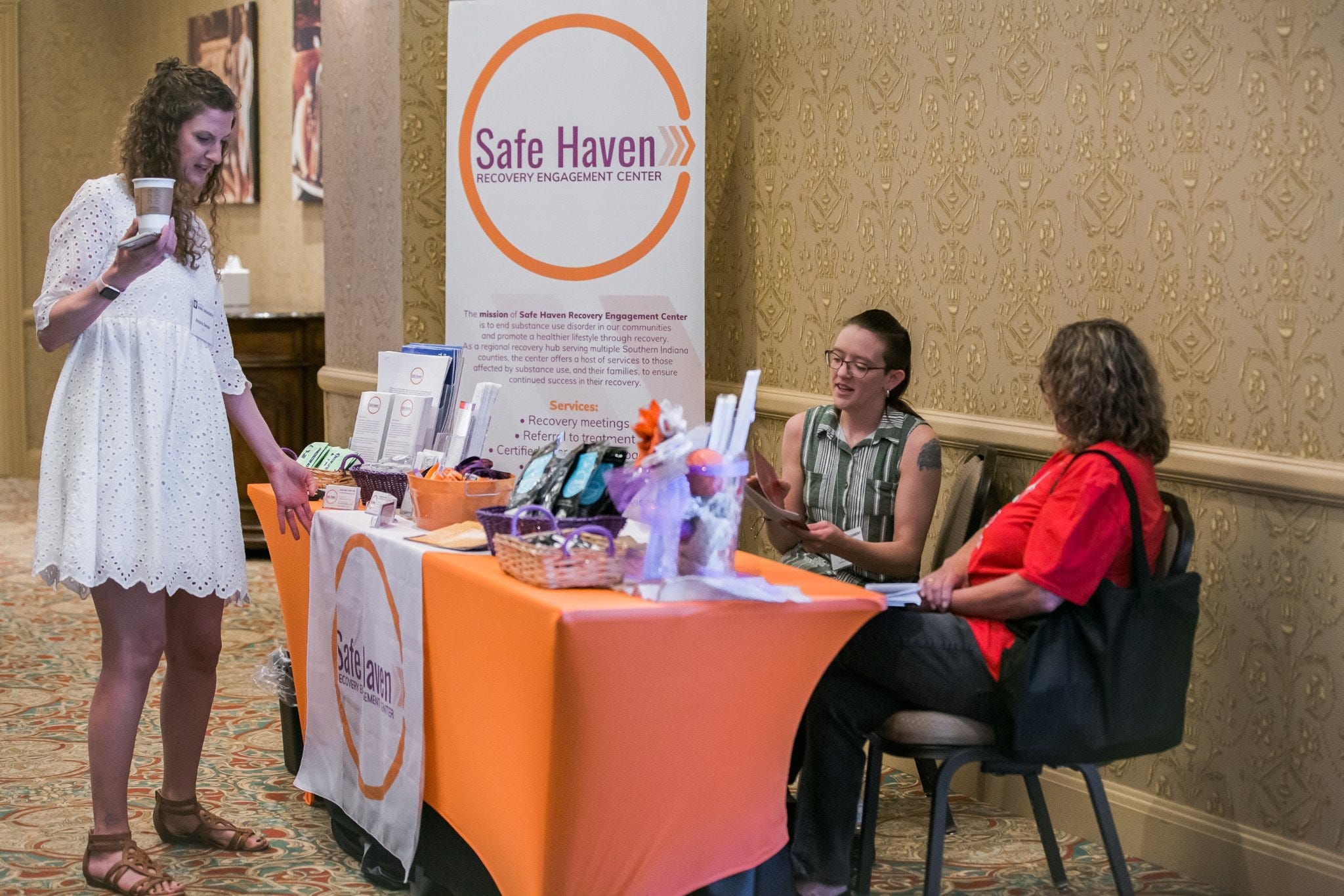
Safe Haven Recovery Engagement Center of Orange County, IN tabling at the IU Rural Conference, 2024. Photo courtesy of Safe Haven Recovery Engagement Center.
One main point of this essay is that we should pay more attention to the frontlines of rural America. Data centers are the primary battle getting that attention at the moment, so let’s get into it.
Indiana currently has five data centers under construction with 36 more proposed.45 In Indiana, data centers tend to have the endorsement of oil and coal industries. In other states, Meta, Google, and others have proposed using renewable energy or nuclear energy to power data centers. Not in Indiana.46 What is being proposed (in fact aggressively lobbied) by fossil fuel industries is to build new natural gas and coal power plants as well as resurrect old plants that had been sunsetted.47 The sunsetting of these facilities were hard-won fights in communities living with the toxic footprint of fossil fuel industries for decades, sometimes generations. One young woman at the conference described that for much of her life her father’s job was overseeing the decommissioning of a coal plant. Just recently he got notice that all of his work was going to be reversed and the plant was going active again to power a data center. Organizers at the conference noted that in Indiana, the oil and coal industries “could care less” whether the data center boom goes bust, because once they have more plants open, it will take decades to sunset them again.48 For them, it’s a win no matter what.
Data centers are offering to bail out rural communities who are on the brink of collapse, including some communities whose local governments previously banned investment in wind and solar. Let this be another lesson in the fact that the wrong people often pay close attention to rural areas where the rest of the world turns its back. Fossil fuel lobbyists worked tirelessly convincing rural jurisdictions to block wind and solar from their communities. Some grassroots efforts fought valiantly to bring renewable energy to rural areas, but they were outgunned, by far, and largely unaided by highly-resourced proponents of environmental justice elsewhere in the country.
One proposed data center in Marion County would disrupt the White River so aggressively that it would permanently alter agriculture in the entire rest of the state south of the river.49
During the COVID-19 pandemic, one local farm in the south of the state became the #1 source of meat for all Indiana University campuses.50 Supply chain disruptions forced the university to choose local meat and Fischer Farms in DuBois County rose to the occasion. Mr. Fischer spoke at the conference about how “weird” it is to know that “we could have a self-sustaining local food system” but are voluntarily threatening it to power and water data centers.
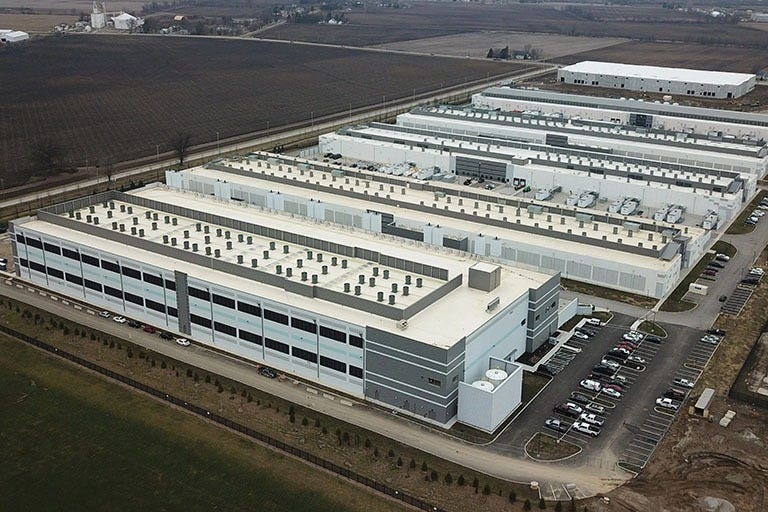
Amazon’s data center campus in New Carlisle, Indiana. Photo courtesy of South Bend Tribune.
One member of Earth Charter Indiana, an environmental justice non-profit, attended a conference in Chicago for data center developers. He reported51 that the developers at the conference described Indiana as having the “perfect conditions” for data centers. He said the developers spoke openly of the toxic footprint of data centers, that they “didn’t try to hide the cost, rather, they didn’t care.” According to the reports of this Earth Charter member, one of the keynote speakers at the Chicago conference was a counter-insurgency expert who presented on defeating resistance from local populations. Developers reportedly spoke of local populations as undeserving of a better life. One claimed, “If they wanted nice things, they shouldn’t have chosen to live in Indiana.”
This disregard is not new to rural areas. It is not new to Indigenous communities. It is not new to urban Black and Brown neighborhoods who bear the brunt of industrialization. All of these places done BEEN sacrificed. “If they wanted nice things, they shouldn’t have chosen to live in _________” has been a lot of different places at a lot of different times. It’s all the same message - “If they wanted nice things, they shouldn’t have been so damn disposable.” People in sacrifice zones have always been disposable.
While writing this article, I talked a lot of it over with a friend who grew up in Chicago. He said, “No offense, but my impression of Indiana is that nothing good happens there and nothing good comes out of there. And that it’s not worth anyone’s time. It’s a bunch of dumb hicks and backwards hillbillies who want to run this country into the ground.” He said, “I’m now realizing that, frankly, I don’t have a clue what is actually going on there. But I am starting to sniff out who benefits from that and who would be very happy for me to keep thinking that it’s a worthless place with worthless people. Keeps anyone from coming for their gold.”
Indiana ranks in the bottom ten of all states for voter turnout, and this is true on local, state, and federal levels.52 Why isn’t anyone trying to win over all these politically silent Hoosiers? Have we ever considered that it suits politicians and big business just fine that most of the country thinks Indiana isn’t worth organizing? Do we realize how effective the propaganda is? Do we see how the narrative that the rural poor and working class are “not worth it” and “too dumb and backwards to work with” functions in tandem with the narrative that poor and working class people in big cities are “dangerous thugs” and “lazy welfare queens?” These narratives might originate from different histories, but they are weaponized together. Used side-by-side, these narratives help isolate and divide the most hard-hit communities in the nation…communities that share common enemies.
People who profit from ghettoizing urban areas and ghettoizing rural areas are the same industries, the same supply chains, the same profit flows. They want people on the South Side of Chicago to view rural people in Indiana as a threat. They want people in rural Indiana to see people on the South Side of Chicago as a threat. Works just fine for them. And somehow we keep blaming the poorest people in the country for not voting themselves out of messes they did not create. The U.S. has the highest rates of poverty in the Global North.53 There’s plenty of blame to go around to both parties, but instead we blame the poor.
Too many states essentially live under one-party rule and their governments face no real accountability. It is to our detriment wherever Democrats have one-party-rule and constantly betray the working poor. It is to our detriment wherever Republicans have one-party-rule and constantly betray the working poor. In many cases the politicians in power in both urban and rural areas are Democrat or Republican in name only. This is not a healthy democracy. Hasn’t been for a while. Meanwhile, the stories we inherit, this relentless propaganda, encourages us to wildly overestimate the amount of political choice that poor people have over their circumstances, whether that is urban or rural. The powerful keep making a killing. Meanwhile, we blame the most vulnerable people for just not being good enough.
In reality, most marginalized communities are just not organized enough. I am blessed to know so many people who believe that the South and West Sides of Chicago are worth organizing. They put in the hard work in areas that the rest of the country has been told they should be afraid to even step foot in. While I was writing this essay, I hung out with some of these organizer friends at an open mic in Back of the Yards on the South Side of Chicago.54 One poet recited a line that I haven’t been able to get out of my head: “keep the KKK out the crops.”55
That line felt like such a cutting metaphor for this entire report-back about resistance in rural areas. There are a lot of frontlines in the world right now, plenty to go around. But if you wanna keep the KKK out the crops, where is that frontline? Maybe the people doing that work also live in communities that the rest of the country has been told to stay the hell away from. If you want to keep Meta out of the water table, if you wanna keep child labor laws on the books, if you want to keep healing from the war on drugs, you have to look at rural America. If you want to know how communities are somehow surviving with the lowest wages, the least public infrastructure, and the worst access to funding, you gotta pay attention to rural America. And if you want to know about how rural America has always fought back, you need to ask the high schoolers in French Lick, Indiana.
Presentation by Angela Sorg, Purdue Extension Service, on May 12th, 2025
Presentation by Wendy Noe and Megan Durlauf, Dove Recovery House for Women, on May 12th, 2025
Fidler, H. (2025). Truth comes before reconciliation: An exercise in American truth-telling. Nebraska Journal on Advancing Justice, 2(1), 11-55. https://digitalcommons.unl.edu/njaj/vol2/iss1/4
Heaberlin, B., Shattuck, A. (2023). Farm stress and the production of rural sacrifice zones. Journal of Rural Studies, 97, 70-80. https://doi.org/10.1016/j.jrurstud.2022.11.007
Keesler, J., Tucker, M., Terrell, B., & Shipman, K. (2021). Two schools, one rural county: Exploring adverse childhood experiences among school-aged youth. Journal of Aggression, Maltreatment, and Trauma, 30(1), 101-117. https://doi.org/10.1080/10926771.2020.1747130
Presentation by Beck Scott, Positive Expectations LLC, on May 20th, 2026
Presentation by Jennefier Stefancik and Nasreen Lalani, Purdue Extension Services, on May 19th, 2026
Presentation by Jennefier Stefancik and Nasreen Lalani, Purdue Extension Services, on May 19th, 2026
Presentation by Kelly Bernedo, IU Southeast, and Jose Martinez Molinero, Seymour Community Schools, on May 13th, 2025
Reding, N. (2010). Methland: The Death and Life of an American Small Town. Bloomsbury.
Presentation by Philip Barash and Lucas Cowan, Public Spheres Projects, on May 20th, 2026
Presentation by Jennifer Knight, Green County Ambulance Service, on May 19th, 2026
Presentation by Brittany Stout, Safe Haven Recovery Engagement Center, on May 13th, 2024
Presentation by Rachel Mueller, IU School of Public Health, Nancy Ekerle and Kiersten Knies, City of Jasper, on May 20th, 2026
Presentation by Shannon Anderson and Kevin Nichols, Earth Charter Indiana, on May 19th, 2026
Presentation by Shannon Anderson and Kevin Nichols, Earth Charter Indiana, on May 19th, 2026
Comments made by David Fischer, Fischer Farms, during “Stewardship and Resilience” keynote panel, May 20th, 2026
Presentation by Shannon Anderson and Kevin Nichols, Earth Charter Indiana, on May 19th, 2026
Barber II, W.J. (2024). White poverty: How exposing myths about race and class can reconstruct American democracy. Liveright Publishing Corporation.
Hosted by Joliet poet laureate Uxmar Torres and Back of the Yards Coffeehouse, see link to event flyer
Unreleased poem by Chris Rod, recited May 23rd, 2026 at Back of the Yards Coffeehouse


